Surface disinfection for livestock production
We reduce the risk of contamination in the livestock environment
We effectively disinfect surfaces and working areas, thereby supporting biosecurity, animal health and production safety.
Disinfected area counter
m2 of protected space
Estimated figures based on installations we service
Why does simply rinsing with water
not solve the biofilm problem?
In livestock production, microbiological hazards can persist not only on surfaces, but also in the air space of the building, hard-to-reach areas, crevices, equipment and biofilm developing on process surfaces. Standard cleaning often does not cover the entire volume of the building and places beyond the reach of manual application. EHT disinfection using ClO₂ technology and ULV fogging supports effective microbiological control in livestock facilities and biosecurity zones.
Why is standard disinfection not always sufficient?
In production environments, microorganisms can develop:
- in biofilm,
- in process systems,
- in CIP areas,
- in structural crevices,
- and in spaces that are hard to reach with standard cleaning.
Surface disinfection often eliminates only the visible problem without removing the source of microbiological contamination.
EHT technology based on ClO₂ and ULV fogging makes it possible to effectively cover both surfaces and production spaces in the disinfection process, reducing the risk of recurring contamination.
Standard disinfection
Acts mainly locally and may not reach large building volumes, crevices, structural components, hard-to-access areas or places beyond the reach of manual application.
Disinfection
EHT
Uses ClO₂ technology and ULV fogging, enabling even disinfection of surfaces, equipment, large building volumes and biosecurity zones.
Every industry has different challenges. We tailor the solution
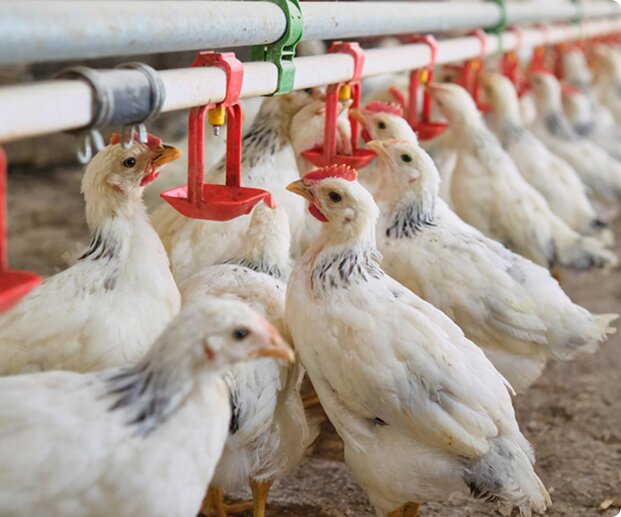
Livestock houses and poultry houses
Large building volumes, work surfaces and spaces in livestock facilities require disinfection that reduces the risk of spreading viruses, bacteria and other pathogens.
Biosecurity zones
Hygiene locks, service entrances, staff passageways and high-risk zones require effective microbiological control to support the safety of the entire farm.
Process surfaces and equipment
Process lines, farm equipment, conveyors, containers and work surfaces can harbour microorganisms and surface biofilm.
Hard-to-reach spaces
Crevices, structural components, enclosed spaces and places beyond the reach of manual application require technology that disinfects the entire space of the facility.
Disinfection of hatching eggs
ULV fogging with ClO₂ can support even disinfection coverage of the egg surface and reduce the risk of microorganism transfer in the hatchery environment.
Poultry facilities and production farms
In poultry production, microbiological control of spaces, equipment and transition zones is crucial for biosecurity and for reducing the risk of infectious diseases.
High biological risk zones
Areas exposed to pathogens such as avian influenza, ASF, Salmonella or E. coli require a process tailored to the level of threat and the specifics of the farm.
What do you gain with EHT technology?
Higher level of biosecurity: EHT disinfection helps to reduce microbiological hazards in livestock houses, poultry houses, transition zones and high-risk areas.
Lower risk of secondary infection: the process helps to reduce microorganisms present on surfaces, equipment, infrastructure components and throughout the facility.
Microbiological control of surfaces and spaces: ULV fogging enables even distribution of the disinfectant across large spaces and hard-to-reach places.
Disinfection of large spaces: ULV technology is ideal for livestock houses, poultry houses and production facilities, where standard manual application may be insufficient.
Supporting farm safety: microbiological control helps to reduce the risk of viruses, environmental bacteria and pathogens spreading.
Reduced biofilm on surfaces: disinfection helps to eliminate biofilm developing on process surfaces, equipment and livestock infrastructure.
Support for hatching egg disinfection: ULV technology using ClO₂ can support modern microbiological control of hatching eggs and the hatchery environment.
A process tailored to your facility: we match the technology, parameters and application method to the type of livestock operation, facility size, level of biological risk and biosecurity requirements.
Modern ULV and ClO₂ technologies: combining ULV fogging with ClO₂ technology supports effective disinfection of surfaces, spaces, equipment and biosecurity zones.
What does the EHT microbiological control process involve?
Analysis of risk and the production environment
We assess the level of microbiological hazards, critical areas and locations at increased risk of biofilm formation.
Selection of technology and process parameters
We design a disinfection process tailored to the type of installation, the nature of production, and the operational requirements of the plant.
Carrying out disinfection
We carry out professional disinfection of surfaces and spaces using ClO₂ and ULV technology.
Verification of effectiveness and recommendations
We verify the effectiveness of the process and prepare recommendations to help maintain high standards of production hygiene.
Disinfection is a reaction.
Microbiological control is a strategy.
Corrective disinfection
Carried out in the event of:
- detection of contamination,
- quality problems,
- recurring microorganisms,
- the need to secure production quickly.
The aim of the process is to reduce the threat and restore safe production conditions.
Preventive disinfection
Regular measures supporting:
- stable microbiology of the production environment,
- reduced risk of contamination,
- product safety,
- operational continuity of the plant,
- maintaining high hygiene standards.
Modern disinfection is not just about reacting. It is about creating an environment in which microbiological threats have limited scope to develop.
CUSTOMERS
Trusted by


TESTIMONIALS
Customer testimonials
We are trusted by clients for whom hygiene, safety and process efficiency are of key importance.
(...) We rate our cooperation with EHT Poland as professional, well organised and based on measurable parameters. The company provides genuine technical support and consistently demonstrates the results achieved on the farm. (...)
Gawlica Rafał Farm
(...) the greatest benefit was the improved control over water hygiene and the practical technical support. The solution was implemented under real production conditions, taking into account the specific characteristics of the farm and the production cycle. (...)
Agnieszka and Przemysław Firgan Farm
(...) In our view, the cooperation is conducted reliably and competently, and ongoing technical supervision has made it possible to stabilise the operation of the water system and improve production safety. (...)
PANKOWSCY Sp. z o.o.
(...) We recommend EUROPEAN HYGIENE TECH POLAND Sp. z o.o. as a reliable and effective partner in the field of water hygiene, the disinfection of water systems and measures to mitigate microbiological risks in public facilities. (...)
in Strzelce Opolskie
(...) Based on our cooperation to date, we can recommend EUROPEAN HYGIENE TECH POLAND Sp. z o.o. and the ProOxine product as an effective solution for maintaining clean water and hygiene of drinking-water lines in poultry production.
BIWET S.C. Veterinary Practice
Michał Brzeski
Piotr Górny
Arkadiusz Górny
ABOUT US
Over 15 years’ experience
in biosecurity
15+
years of experience in international markets.
completed implementations in industrial systems.
countries served
(Poland, Scandinavia, the Baltic States, Western Europe).
QUALIFICATIONS
Quality confirmed by tests and certificates
The effectiveness of our solutions is confirmed by research, approvals and certificates recognised in demanding industries.
Certificates:
OMRI Listed®
Organic Materials Review Institute
Hygiene Certificate
National Institute of Public Health (PZH)
– State Research Institute
ISO 9001:2015
The Certification Body of TÜV SÜD America Inc.
Tests carried out in accordance with the following standards:
STAY UP TO DATE
Knowledge base
FAQ
Frequently asked questions
Why is the disinfection of livestock facilities important?
In livestock production, microbiological hazards can persist on surfaces, in the air space of buildings, crevices, equipment and surface biofilm. This can affect farm safety and the level of biosecurity.
Which areas can be disinfected?
The process can cover livestock houses, poultry houses, biosecurity zones, hygiene locks, service entrances, work surfaces, conveyors, containers and farm equipment.
Can EHT disinfection cover large building volumes?
Yes. ULV fogging enables even distribution of the disinfectant in large livestock buildings, poultry houses and hard-to-reach spaces.
Which biological hazards are particularly important in livestock production?
The main threats include avian influenza, ASF, Salmonella, E. coli, environmental viruses and bacteria, and biofilm on process surfaces.
Can EHT technology support the disinfection of hatching eggs?
Yes. ULV fogging with ClO₂ can support even disinfection coverage of the egg surface and reduce the risk of microorganism transfer in the hatchery environment.