

Even minor contamination can lead to serious consequences:
- health hazards,
- quality problems,
- production strategies,
- downtime,
- costly remedial action.
In many cases, the source of the problem is bacteria developing in biofilms, water installations, the production environment, or difficult-to-access technical spaces.
Discover 5 bacteria that most commonly pose a serious threat to farming and food processing.

1. Listeria monocytogenes
One of the biggest threats to food processing
Listeria monocytogenes is a bacterium particularly dangerous for facilities producing ready-to-eat food and products requiring a high level of hygiene in the production environment.
The biggest problem is its ability to:
- development at low temperatures,
- biofilm formation,
- survival in damp environments,
- colonisation of hard-to-access infrastructure elements.
Listeria can grow in, amongst other things:
- in drains,
- refrigeration systems,
- in structural gaps,
- production lines,
- contact surfaces.
In practice, this means a high risk of re-contamination despite regular disinfection.
2. Salmonella
Bacteria particularly dangerous in animal production
Salmonella is one of the most frequently monitored bacteria in farming and the food industry.
It can spread through:
- water,
- fodder,
- production areas,
- equipment,
- means of transport,
- Contact between objects.
The greatest risk associated with Salmonella stems from its ability to spread rapidly in production and breeding environments.
Inadequate biosecurity and ineffective disinfection can lead to regular recurrences of the problem.

3. Escherichia coli (E. coli)
Indicator of sanitary problems and environmental pollution
Not all strains of E. coli are dangerous, however the presence of bacteria from this group very often indicates problems related to environmental hygiene or contamination of installations.
E. coli can appear:
- in water installations,
- connection system,
- in a breeding environment,
- on production surfaces.
This bacterium particularly spreads easily in conditions:
- under high humidity,
- presence of organic deposits,
- ineffective microbiology control.
Her presence often indicates the need for a more thorough biological safety assessment of the facility.
4. Campylobacter
One of the most common causes of poultry-related infections
Campylobacter is particularly common in environments associated with poultry production.
Bacteria can grow:
- in watering systems,
- on production surfaces,
- in a breeding environment,
- in areas of high humidity.
A major problem is the fact that Campylobacter can spread very quickly and remain difficult to detect for a long time.
This is why effective environmental hygiene control and regular disinfection are crucial for limiting risk.
5. Pseudomonas
An extremely problematic bacterium in water installations
Pseudomonas develops very well in an aquatic environment and within a biofilm.
Can colonise
- plumbing installations,
- tanks,
- Technological systems.,
- cooling systems,
- surfaces constantly exposed to moisture.
This bacterium is particularly problematic because:
- easilymakesa biofilm,
- It can show high environmental resistance,
- rapidly rebuilds its activity after ineffective disinfection.
This is why Pseudomonas very often appears in installations requiring professional sanitisation.
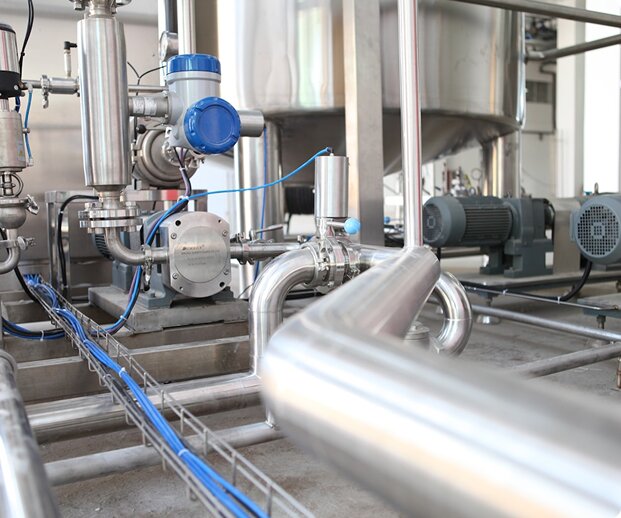
What do the most dangerous bacteria have in common?
Despite their differences, most problematic bacteria share several common characteristics:
- develop in a moist environment,
- can form a biofilm,
- they often remain unseen for a long time,
- They can colonise difficult-to-reach places,
- may regularly cause recurrences of contamination.
Therefore, modern microbiology control does not solely consist of reacting once a problem has emerged.
The following are becoming increasingly important:
- preventive actions,
- Risk analysis,
- Regular inspection of the installation,
- effective disinfection,
- professional sanitisation of water systems and production environments.
The most important
The deadliest bacteria:
- are very often found in biofilms,
- may remain active despite regular disinfection,
- they spread easily in a production environment,
- pose a real threat to production and farming security.
Effective microbiology control requires:
- conscious risk management,
- professional disinfection,
- biofilm control,
- a systematic approach to biosafety.
Summary
Bacteria such as Listeria, Salmonella, E. coli, Campylobacter or Pseudomonas are among the most serious microbiological hazards in food production and processing.
Their common characteristic is the ability to survive in demanding environments and thrive in places difficult to disinfect effectively.
Therefore, modern biosecurity and microbiology control are increasingly based on systemic actions, which aim not only to eliminate the problem but, above all, to limit the conditions favourable to its development.


